-
Disease
-
Arthritis
-
Kidney
-
Organ donation
-
Euthanasia
-
Pregnancy
-
Hand
-
Fine motor skill
-
Drug rehabilitation
-
Cataract
-
Aging-associated diseases
-
Nursing home
-
Support group
-
Psychiatry
-
Lobotomy
-
Sneeze
-
Virus
-
Ambulance
-
Dialysis
-
Medical imaging
-
Medical test
-
Complete blood count
-
Hospital-acquired infection
-
Pneumonia
-
Elsevier
-
Pharmaceutical industry
-
Generic drug
-
Antibiotic resistance
-
Bioavailability
-
Dietary supplement
-
HIV / AIDS
-
Epidemic
-
Ignaz Semmelweis
-
Wart
-
Heat illness
-
Heart rate
-
Blood group systems
-
International Society of Blood Transfusion
-
Cardiopulmonary resuscitation
-
Unified Medical Language System
-
Self-diagnosis
-
Homeopathy
-
Naturopathy
-
Massage
-
Drowning
-
Nose
-
Influenza
-
Anorexia (symptom)
-
Weight loss
-
Exercise physiology
|
Ambulance

Text is available under the
Creative Commons Attribution-ShareAlike License; additional
terms may apply. See
Terms of
Use for details.
Wikipedia® is a registered trademark of the
Wikimedia Foundation,
Inc., a non-profit organization.
Traduzione
interattiva on/off
- Togli il segno di spunta per disattivarla

An ambulance is a
vehicle
for transportation of sick or injured people to, from or between places
of treatment for an
illness or
injury,[1]
and in some instances will also provide out of hospital medical care to
the patient. The word is often associated with road going emergency
ambulances which form part of an
emergency medical service, administering
emergency care to those with acute medical problems.
The term ambulance does, however, extend to a wider range of
vehicles other than those with flashing
warning lights and
sirens. The term also includes a large number of non-urgent
ambulances which are for transport of patients without an urgent acute
condition (see
functional types, below) and a wide range of urgent and non-urgent
vehicles including trucks, vans, bicycles,
motorbikes, station wagons, buses,
helicopters,
fixed-wing aircraft, boats, and even
hospital ships (see
vehicle
types, also below).
The term ambulance comes from the
Latin
word ambulare, meaning to walk or move about[2]
which is a reference to early medical care where patients were moved by
lifting or wheeling. The word originally meant a moving hospital, which
follows an army in its movements.[3]
During the
American Civil War vehicles for conveying the wounded off the field
of battle were called ambulance wagons.[4]
Field hospitals were still called ambulances during the
Franco-Prussian War[5]
of 1870 and in the Serbo-Turkish war of 1876[6]
even though the wagons were first referred to as ambulances about 1854
during the
Crimean War.[7]
There are other types of ambulance, with the most common being the
patient transport ambulance (sometimes called an
ambulette). These vehicles are not usually (although there are
exceptions) equipped with life-support equipment, and are usually crewed
by staff with fewer qualifications than the crew of emergency
ambulances. Their purpose is simply to transport patients to, from or
between places of treatment. In most countries, these are not equipped
with flashing lights or sirens. In some jurisdictions there is a
modified form of the ambulance used, that only carries one member of
ambulance crew to the scene to provide care, but is not used to
transport the patient.[8]
Such vehicles are called
fly-cars. In these cases a patient who requires transportation to
hospital will require a patient-carrying ambulance to attend in addition
to the fast responder.
History

Early car-based ambulances, like this 1948 Cadillac
Meteor, were sometimes also used as
hearses.
The history of the ambulance begins in
ancient times, with the use of
carts to
transport incurable patients by force. Ambulances were first used for
emergency transport in 1487 by the Spanish, and civilian variants were
put into operation during the 1830s.[9]
Advances in technology throughout the 19th and 20th centuries led to the
modern self-powered ambulances.
Functional types
Ambulances can be grouped into types depending on whether or not they
transport patients, and under what conditions. In some cases, ambulances
may fulfil more than one function (such as combining emergency ambulance
care with patient transport).
- Emergency ambulance – The most common type of ambulance,
which provide care to patients with an acute illness or injury.
These can be road-going vans, boats, helicopters, fixed-wing
aircraft (known as
air ambulances) or even converted vehicles such as
golf carts.
- Patient transport ambulance – A vehicle, which has the
job of transporting patients to, from or between places of medical
treatment, such as hospital or
dialysis center, for non-urgent care. These can be vans, buses
or other vehicles.
- Response unit – Also known as a
fly-car or a [Quick Response Vehicle], which is a
vehicle which is used to reach an acutely ill patient quickly, and
provide on scene care, but lacks the capacity to transport the
patient from the scene. Response units may be backed up by an
emergency ambulance which can transport the patient, or may deal
with the problem on scene, with no requirement for a transport
ambulance. These can be a wide variety of vehicles, from standard
cars, to modified vans, motorcycles,
pedal
cycles,
quad bikes or horses. These units can function as a vehicle for
officers or supervisors (similar to a
fire chief's vehicle, but for ambulance services).
- Charity ambulance – A special type of patient transport
ambulance is provided by a charity for the purpose of taking sick
children or adults on trips or vacations away from hospitals,
hospices or care homes where they are in long term care. Examples
include the United Kingdom's 'Jumbulance' project.[10]
These are usually based on a bus.
-
Bariatric ambulance – A special type of patient transport
ambulance designed for extremely obese patients equipped with the
appropriate tools to move and manage these patients.
Vehicle types
Ambulances can be based on many types of vehicle, although emergency
and
disaster conditions may lead to other vehicles serving as makeshift
ambulances:
- Van or
pickup truck – A typical ambulance is based on either the
chassis of a van (vanbulance) or pickup truck. This chassis is then
modified to the designs and specifications of the purchaser.
- Car/SUV
– Used either as a
fly-car for rapid response[8]
or for patients who can sit, these are standard car models adapted
to the requirements of the service using them. Some cars are capable
of taking a
stretcher with a recumbent patient, but this often requires the
removal of the front passenger seat, or the use of a particularly
long car. This was often the case with early ambulances, which were
converted (or even serving)
hearses,
as these were some of the few vehicles able to accept a human body
in a
supine position.

Mercedes-Benz Sprinter ambulance typically used in England,
Wales and Northern Ireland
- Motorcycle – In developed areas, these are used for rapid
response in an emergency[11]
as they can travel through heavy traffic much faster than a car or
van.
Trailers or
sidecars can make these patient transporting units.[12][13]
See also
motorcycle ambulance.
- Bicycle – Used for response, but usually in
pedestrian-only areas where large vehicles find access difficult.[14][15]
Like the motorcycle ambulance, a bicycle may be connected to a
trailer for patient transport, most often in the developing world.[16]
See also
cycle responder.
-
All-terrain vehicle (ATV) – for example quad bikes; these
are used for response off road,[17]
especially at events. ATVs can be modified to carry a stretcher, and
are used for tasks such as
mountain rescue in inaccessible areas.
-
Golf cart or
Neighborhood Electric Vehicle – Used for rapid response at
events[18]
or on campuses. These function similarly to ATVs, with less rough
terrain capability, but with less noise.
-
Helicopter – Usually used for emergency care, either in
places inaccessible by road, or in areas where speed is of the
essence, as they are able to travel significantly faster than a road
ambulance.[19]
Helicopter and fixed-wing ambulances are discussed in greater detail
at
air ambulance.
-
Fixed-wing aircraft – These can be used for either acute
emergency care in remote areas (such as in Australia, with the 'Flying
Doctors'[20]),
for patient transport over long distances (e.g. a re-patriation
following an illness or injury in a foreign country[21]),
or transportation between distant hospitals. Helicopter and
fixed-wing ambulances are discussed in greater detail at
air ambulance.
- Boat – Boats can be used to serve as ambulances,
especially in island areas[22]
or in areas with a large number of canals, such as the
Venetian
water ambulances. Some
lifeboats or
lifeguard vessels may fit the description of an ambulance as
they are used to transport a casualty.
- Ship – Ships can be used as
hospital ships, mostly operated by national military services,[23]
although some ships are operated by charities.[24]
They can meet the definition of ambulances as they provide transport
to the sick and wounded (along with treatment). They are often
sent to disaster or war zones to provide care for the casualties
of these events.
- Bus – In some cases, buses can be used for multiple
casualty transport, either for the purposes of taking patients on
journeys,[10]
in the context of
major incidents, or to deal with specific problems such as
drunken patients in town centres.[25][26]
Ambulance busses are discussed at greater length in
their own article.
- Trailer – In some instances a trailer, which can be towed
behind a self-propelled vehicle can be used. This permits
flexibility in areas with minimal access to vehicles, such as on
small islands.[27]
- Horse and cart – Especially in developing world areas,
more traditional methods of transport include transport such as
horse and cart, used in much the same way as motorcycle or bicycle
stretcher units to transport to a local clinic.
-
Hospital train – Early hospital trains functioned to carry
large numbers of wounded soldiers.[28]
Similar to other ambulance types, as Western medicine developed,
hospital trains gained the ability to provide treatment. In some
rural locations, hospital trains now function as mobile hospitals,
traveling by rail from one location to the next, then parking on a
siding to provide hospital services to the local population.[29]
Hospital trains also find use in
disaster response[29]
Vehicle type
gallery
-
A paramedic's scooter in Israel
-
-
-
-
-
Soviet-made ambulance Type
RAF-2203 "Latvija" as used in Bulgaria until the end of
the 1990s
Design and
construction
Ambulance design must take into account local conditions and
infrastructure. Maintained roads are necessary for road going ambulances
to arrive on scene and then transport the patient to a hospital, though
in rugged areas
four-wheel drive or all-terrain vehicles can be used.
Fuel must
be available and service facilities are necessary to
maintain the vehicle.

Car-based ambulance in Sweden

Truck based ambulance in the United States using a pre-built
box system
Methods of summoning (e.g. telephone) and
dispatching ambulances usually rely on
electronic equipment, which itself often relies on an intact
power grid. Similarly, modern ambulances are equipped with
two-way radios[30][31]
or
cellular telephones to enable them to contact hospitals, either to
notify the appropriate hospital of the ambulance's pending arrival, or,
in cases where physicians do not form part of the ambulance's crew, to
confer with a physician for medical oversight.[32]
Ambulances often have two manufacturers. The first is frequently a
manufacturer of light trucks or full-size vans (or previously, cars)
such as
Mercedes-Benz,
Nissan,
Toyota, or
Ford.[33]
The second manufacturer (known as
second stage manufacturer) purchases the vehicle (which is sometimes
purchased
incomplete, having no body or interior behind the driver's seat) and
turns it into an ambulance by adding bodywork,
emergency vehicle equipment, and interior fittings. This is done by
one of two methods – either
coachbuilding, where the modifications are started from scratch and
built on to the vehicle, or using a modular system, where a pre-built
'box' is put on to the empty
chassis
of the ambulance, and then finished off.
Modern ambulances are typically powered by
internal combustion engines, which can be powered by any
conventional fuel, including
diesel, gasoline or
liquefied petroleum gas,[34][35]
depending on the preference of the operator and the availability of
different options. Colder regions often use gasoline powered engines, as
diesels can be difficult to start when they are cold. Warmer regions may
favor diesel engines, as they are thought to be more efficient and more
durable. Diesel power is sometimes chosen due to safety concerns, after
a series of fires involving gasoline powered ambulances during the
1980s. These fires were ultimately attributed in part to gasoline's
higher
volatility in comparison to diesel fuel.[36][37]
The type of engine may be determined by the manufacturer: in the past
two decades,
Ford[38][39][40]
would only sell vehicles for ambulance conversion if they are diesel
powered. Beginning in 2010, Ford will sell its ambulance chassis with a
gasoline engine in order to meet emissions requirements.[41]
Standards
In the United States, the
General Services Administration has published a series of standards
for ambulance construction, most recently in 2007,[42]
which has been adopted by many states and localities, such as Nebraska,[43]
Illinois,[44]
Mississippi,[45]
Oregon,[46]
and Decatur County, Indiana.[47]
This standard is due to be withdrawn in 2015, in favor of the
National Fire Protection Association's
NFPA 1917.[43]
Safety
Ambulances, like other
emergency vehicles, are required to operate in all weather
conditions, including those during which civilian drivers often elect to
stay off the road. Also, the ambulance crew's responsibilities to their
patient often preclude their use of safety devices such as
seat
belts. Research has shown that ambulances are more likely to be
involved in
motor vehicle collisions resulting in injury or death than either
fire trucks or
police cars. Unrestrained occupants, particularly those riding in
the patient-care compartment, are particularly vulnerable.[48]
When compared to civilian vehicles of similar size, one study found that
on a per-accident basis, ambulance collisions tend to involve more
people, and result in more injuries.[49]
An 11-year retrospective study concluded in 2001 found that although
most fatal ambulance crashes occurred during emergency runs, they
typically occurred on improved, straight, dry roads, during clear
weather.[50]
Furthermore, paramedics are also at risk in ambulances while helping
patients, as 27 paramedics have died during ambulance trips in the US
since 1991.[51]
Equipment

Interior of a mobile intensive care unit (MICU) ambulance
from
Graz, Austria

Four stages of deployment on an ambulance
tail lift
In addition to the equipment directly used for the treatment of
patients, ambulances may be fitted with a range of additional equipment
which is used in order to facilitate patient care. This could include:
- Two-way radio – One of the most important pieces of
equipment in modern emergency medical services as it allows for the
issuing of jobs to the ambulance, and can allow the crew to pass
information back to control or to the hospital (for example a
priority
ASHICE
message to alert the hospital of the impending arrival of a critical
patient.)[31][32]
More recently many services world wide have moved from traditional
analog
UHF/VHF
sets, which can be monitored externally, to more secure digital
systems, such as those working on a
GSM
system, such as
TETRA.[52]
-
Mobile data terminal – Some ambulances are fitted with
Mobile data terminals (or MDTs), which are connected wirelessly
to a central computer, usually at the control center. These
terminals can function instead of or alongside the two-way radio and
can be used to pass details of jobs to the crew, and can log the
time the crew was mobile to a patient, arrived, and left scene, or
fulfill any other computer based function.[53]
- Evidence gathering
CCTV – Some ambulances are now being fitted with video
cameras used to record activity either inside or outside the
vehicle. They may also be fitted with sound recording facilities.
This can be used as a form of protection from violence against
ambulance crews,[54]
or in some cases (dependent on local laws) to prove or disprove
cases where a member of crew stands accused of
malpractice.
-
Tail lift or ramp – Ambulances can be fitted with a tail
lift or ramp in order to facilitate loading a patient without having
to undertake any lifting. This is especially important where the
patient is
obese or specialty care transports that require large, bulky
equipment such as a
neonatal incubator or
hospital beds. There may also be equipment linked to this such
as
winches which are designed to pull heavy patients into the
vehicle.[55]
- Trauma lighting – In addition to normal working lighting,
ambulances can be fitted with special lighting (often blue or red)
which is used when the patient becomes
photosensitive.
-
Air conditioning – Ambulances are often fitted with a
separate air conditioning system to serve the working area from that
which serves the cab. This helps to maintain an appropriate
temperature for any patients being treated, but may also feature
additional features such as
filtering against airborne pathogens.
- Data Recorders – These are often placed in ambulances to
record such information as speed, braking power and time, activation
of active emergency warnings such as lights and sirens, as well as
seat belt usage. These are often used in coordination with
GPS units.[56]
Intermediate
technology
In parts of the world which lack a high level of infrastructure,
ambulances are designed to meet local conditions, being built using
intermediate technology. Ambulances can also be trailers, which are
pulled by bicycles, motorcycles, tractors, or animals. Animal-powered
ambulances can be particularly useful in regions that are subject to
flooding. Motorcycles fitted with
sidecars (or
motorcycle ambulances) are also used, though they are subject to
some of the same limitations as more traditional over-the-road
ambulances. The level of care provided by these ambulances varies
between merely providing transport to a medical clinic to providing
on-scene and continuing care during transport.[12]
The design of intermediate technology ambulances must take into
account not only the operation and maintenance of the ambulance, but its
construction as well. The robustness of the design becomes more
important, as does the nature of the skills required to properly operate
the vehicle. Cost-effectiveness can be a high priority.[13][57]
Appearance
and markings
Emergency ambulances are highly likely to be involved in hazardous
situations, including incidents such as a
road traffic collision, as these emergencies create people who are
likely to be in need of treatment. They are required to gain access to
patients as quickly as possible, and in many countries, are given
dispensation from obeying certain traffic laws. For instance, they may
be able to treat a red
traffic light or stop sign as a
yield sign ('give way'),[58]
or be permitted to break the speed limit.[59]
Generally, the priority of the response to the call will be assigned by
the dispatcher, but the priority of the return will be decided by the
ambulance crew based on the severity of the patient's illness or injury.
Patients in significant danger to life and limb (as determined by
triage)
require urgent treatment by advanced medical personnel,[60]
and because of this need, emergency ambulances are often fitted with
passive and active visual and/or audible warnings to alert road users.
Passive
visual warnings
The passive visual warnings are usually part of the design of
the vehicle, and involve the use of high contrast patterns. Older
ambulances (and those in
developing countries) are more likely to have their pattern painted
on, whereas modern ambulances generally carry
retro-reflective designs, which reflects light from car headlights
or torches. Popular patterns include 'checker board' (alternate coloured
squares, sometimes called 'Battenburg',
named after a
type of cake), chevrons (arrowheads – often pointed towards the
front of the vehicle if on the side, or pointing vertically upwards on
the rear) or stripes along the side (these were the first type of
retro-reflective device introduced, as the original reflective material,
invented by 3M,
only came in tape form). In addition to retro-reflective markings, some
services now have the vehicles painted in a bright (sometimes
fluorescent) yellow or orange for maximum visual impact.
Another passive marking form is the word ambulance (or local
language variant) spelled out in reverse on the front of the vehicle.
This enables drivers of other vehicles to more easily identify an
approaching ambulance in their
rear view mirrors. Ambulances may display the name of their owner or
operator, and an
emergency telephone number for the ambulance service.
Ambulances may also carry an emblem (either as part of the passive
warning markings or not), such as a Red Cross, Red Crescent or Red
Crystal (collective known as the
Protective Symbols). These are symbols laid down by the
Geneva Convention, and all countries signatory to it agree to
restrict their use to either (1) Military Ambulances or (2) the national
Red Cross or
Red Crescent society. Use by any other person, organization or
agency is in breach of international law. The protective symbols are
designed to indicate to all people (especially combatants in the case of
war) that the vehicle is neutral and is not to be fired upon, hence
giving protection to the medics and their casualties, although this has
not always been adhered to. In Israel,
Magen David Adom, the Red Cross member organization use a red
Star of David, but this does not have recognition beyond Israeli
borders, where they must use the Red Crystal.
The
Star of Life is widely used, and was originally designed and
governed by the U.S.
National Highway Traffic Safety Administration,[61]
because the Red Cross symbol is legally protected by both National[62]
and international[63][64]
law. It indicates that the vehicle's operators can render their given
level of care represented on the six pointed star.
Ambulance services that have historical origins such as the
Order of St John, the
Order of Malta Ambulance Corps[65]
and
Malteser International[66]
often use the
Maltese cross to identify their ambulances. This is especially
important in countries such as Australia, where
St. John Ambulance operate one state and one territory ambulance
service, and all of Australia's other ambulance services use variations
on a red Maltese cross.[67][68][69][70]
Fire service operated ambulances may display the Cross of
St. Florian (often incorrectly called a Maltese cross) as this cross
is frequently used as a fire department logo (St. Florian being the
patron saint of
firefighters).[71]
Active visual
warnings

An ambulance in Denmark with roof-integrated LED lights,
plus side-view mirror, grill and front fend-off lights, and
fog lamps wig-wags
The active visual warnings are usually in the form of flashing
lights. These flash in order to attract the attention of other road
users as the ambulance approaches, or to provide warning to motorists
approaching a stopped ambulance in a dangerous position on the road.
Common colours for ambulance warning beacons are blue, red, amber, and
white (clear). However the colours may vary by country and sometimes by
operator.
There are several technologies in use to achieve the flashing effect.
These include flashing a
light bulb or
LED, and
strobe lights, which are usually brighter than incandescent lights.
Each of these can be programmed to flash singly or in groups, and can be
programmed to flash in patterns (such as a left -> right pattern for use
when the ambulance is parked on the left hand side of the road,
indicating to other road users that they should move to the right (away
from the ambulance). Incandescent and LED lights may also be programmed
to burn steadily, without flashing.
Emergency lights may be housed in special fittings, such as in a
lightbar, or may be hidden in a host light (such as a
headlamp) by drilling a hole in the host light's reflector and
inserting the emergency light. These hidden lights may not be apparent
until they are activated. Additionally, some of the standard lights
fitted to an ambulance (e.g.
headlamps, tail lamps) may be programmed to flash. Flashing
headlights (typically the high beams, flashed alternately) are known as
a
wig-wag.
In order to increase safety, it is best practice to have 360°
coverage with the active warnings, improving the chance of the vehicle
being seen from all sides. In some countries, such as the United States,
this may be mandatory.
See also
Emergency vehicle equipment.
Audible warnings
A Whelen(R) siren with wail, yelp and
phaser tones is a common sound in many cities
In addition to visual warnings, ambulances can be fitted with
audible warnings, sometimes known as
sirens, which can alert people and vehicles to the presence of an
ambulance before they can be seen. The first audible warnings were
mechanical bells, mounted to either the front or roof of the ambulance.
Most modern ambulances are now fitted with electronic sirens, producing
a range of different noises which ambulance operators can use to attract
more attention to themselves, particularly when proceeding through an
intersection or in heavy traffic.[72]
The speakers for modern sirens can be integral to the lightbar, or
they may be hidden in or flush to the grill to reduce noise inside the
ambulance that may interfere with patient care and radio communications.
Ambulances can additionally be fitted with
airhorn audible warnings to augment the effectiveness of the siren
system.
A recent development is the use of the
RDS system of
car radios. The ambulance is fitted with a short range
FM transmitter, set to RDS code 31, which interrupts the radio of
all cars within range, in the manner of a traffic broadcast, but in such
a way that the user of the receiving radio is unable to opt out of the
message (as with traffic broadcasts).[73]
This feature is built into every RDS radio for use in national emergency
broadcast systems, but short range units on emergency vehicles can prove
an effective means of alerting traffic to their presence. It is,
however, unlikely that this system could replace audible warnings, as it
is unable to alert pedestrians, those not using a compatible radio or
even have it turned off.[74]
Service providers
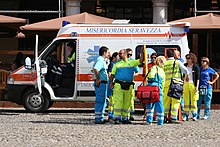
A volunteer ambulance crew in
Modena, Italy

Non-acute patient transport ambulance from New Zealand.
Some countries closely regulate the industry (and may require anyone
working on an ambulance to be qualified to a set level), whereas others
allow quite wide differences between types of operator.
- Government Ambulance Service – Operating separately from
(although alongside) the fire and police service of the area, these
ambulances are funded by local or national government. In some
countries, these only tend to be found in big cities, whereas in
countries such as Great Britain almost all emergency ambulances are
part of a nationwide system under the
National Health Service.[75]
In Canada ambulance services are normally operated by local
municipalities or provincial health agencies as a separate entity
from fire or police services.
- Fire or Police Linked Service – In countries such as the
United States, Japan, Hong Kong and France ambulances can be
operated by the local fire or police service. This is particularly
common in rural areas, where maintaining a separate service is not
necessarily cost effective. In some cases this can lead to an
illness or injury being attended by a vehicle other than an
ambulance, such as a
fire truck.
- Volunteer Ambulance Service – Charities or non-profit
companies operate ambulances, both in an emergency and patient
transport function. This may be along similar lines to volunteer
fire companies, providing the main service for an area, and either
community or privately owned. They may be linked to a voluntary
fire department, with volunteers providing both services. There
are charities who focus on providing ambulances for the community,
or for cover at private events (sports etc.). The
Red Cross provides this service across the world on a volunteer
basis.[76]
(and in others as a Private Ambulance Service), as do other smaller
organisations such as
St John Ambulance[77]
and the
Order of Malta Ambulance Corps.[78]
These volunteer ambulances may be seen providing support to the
full-time ambulance crews during times of emergency. In some cases
the volunteer charity may employ paid members of staff alongside
volunteers to operate a full-time ambulance service, such in some
parts of Australia and in Ireland.
- Private Ambulance Service – Normal commercial companies
with paid employees, but often on contract to the local or national
government. Private companies may provide only the patient transport
elements of ambulance care (i.e. nonurgent or ambulatory transport),
but in some places, they are contracted to provide emergency care,
or to form a 'second tier' response. In many areas private services
cover all emergency transport functions and government agencies do
not provide this service. Companies such as
Falck,
Acadian Ambulance, and
American Medical Response are some of the larger companies that
provide such services. These organisations may also provide services
known as 'Stand-by' cover at industrial sites or at special events .[79]
From April 2011 all private ambulance services in the UK must be
Care Quality Commission (CQC) registered. Private services in Canada
operate non-emergency patient transfers or for private functions
only.
- Combined Emergency Service – these are full service
emergency service agencies, which may be found in places such as
airports or large colleges and universities. Their key feature is
that all personnel are trained not only in ambulance (EMT) care, but
as a firefighter and a peace officer (police function). They may be
found in smaller towns and cities, where size or budget does not
warrant separate services. This multi-functionality allows to make
the most of limited resource or budget, but having a single team
respond to any emergency.
- Hospital Based Service – Hospitals may provide their own
ambulance service as a service to the community, or where ambulance
care is unreliable or chargeable. Their use would be dependent on
using the services of the providing hospital.
- Charity Ambulance – This special type of ambulance is
provided by a charity for the purpose of taking sick children or
adults on trips or vacations away from hospitals, hospices or care
homes where they are in long term care. Examples include the UK's
'Jumbulance' project.[10]
- Company Ambulance – Many large factories and other
industrial centres, such as
chemical plants,
oil refineries,
breweries and
distilleries, have ambulance services provided by employers as a
means of protecting their interests and the welfare of their staff.
These are often used as first response vehicles in the event of a
fire or explosion.
Costs
The cost of an ambulance ride may be paid for from several sources,
and this will depend on the type of service being provided, by whom, and
possibly who to.
- Government funded service – The full or the majority of
the cost of transport by ambulance is borne by the local, regional,
or national government (through their normal taxation).[80]
- Privately funded service – Transport by ambulance is paid
for by the patient themselves, or through their insurance company.
This may be at the point of care (i.e. payment or guarantee must be
made before treatment or transport), although this may be an issue
with critically injured patients, unable to provide such details, or
via a system of billing later on.[81]
- Charity funded service – Transport by ambulance may be
provided free of charge to patients by a charity, although donations
may be sought for services received.[82]
- Hospital funded service – Hospitals may provide the
ambulance transport free of charge, on the condition that patients
use the hospital's services (which they may have to pay for).[83]
Crewing
There are differing levels of qualification that the ambulance crew
may hold, from holding no formal qualification to having a fully
qualified doctor on board. Most ambulance services require at least two
crew members to be on every ambulance (one to drive, and one to attend
the patient), although response cars may have a sole crew member,
possibly backed up by another double-crewed ambulance. It may be the
case that only the attendant need be qualified, and the driver might
have no medical training. In some locations, an
advanced life support ambulance may be crewed by one paramedic and
one EMT-Basic.
Common ambulance crew qualifications are:
-
First responder – A person who arrives first at the scene of
an incident,[84]
and whose job is to provide early critical care such as
cardiopulmonary resuscitation (CPR) or using an
automated external defibrillator (AED). First responders may be
dispatched by the ambulance service, may be passers-by, or may be
dispatched to the scene from other agencies, such as the police or
fire departments.
- Ambulance Driver – Some services employ staff with no
medical qualification (or just a first aid certificate) whose job is
to simply drive the patients from place to place. In some emergency
ambulance contexts this term is a pejorative toward qualified
providers implying that they perform no function but driving,
although it may be acceptable for patient transport or community
operations. In some areas, these drivers would survey and study the
local network of routes for better performance of service, as some
road routes may be blocked, and the driver must know another route
to the patient or to the hospital. The driver would gather the local
weather and traffic status reports before and in-between
emergencies. They may also have training in using the radio and
knowing where medical supplies are stored in the ambulance.
-
Ambulance Care Assistant – Have varying levels of training
across the world, but these staff are usually only required to
perform patient transport duties (which can include stretcher or
wheelchair cases), rather than acute care.[85]
Dependent on provider, they may be trained in first aid or extended
skills such as use of an AED, oxygen therapy and other lifesaving or
palliative skills. They may provide emergency cover when other
units are not available, or when accompanied by a fully qualified
technician or paramedic.
-
Emergency Care Assistant/Emergency Care Support Workers –
Also known as ECA/ECSW are members of a frontline ambulance that
drive the vehicles under both emergency and non-emergency conditions
to incidents. There role is to assist the clinician that they are
working with either a Technician or Paramedic in there duties
whether that be drawing up drugs, setting up fluids (but not
attaching), doing basic observations or performing 12 lead ECG
assessments.
-
Emergency medical technician – Also known as Ambulance
Technician. Technicians are usually able to perform a wide range of
emergency care skills, such as
defibrillation, spinal immobilization, bleeding control,
splinting of suspected fractures, assisting the patient with certain
medications, and
oxygen therapy. Some countries split this term into levels (such
as in the US, where there is
EMT-Basic and
EMT-Intermediate).[86]
-
Paramedic – This is a high level of medical training and
usually involves key skills not permissible for technicians, such as
cannulation (and with it the ability to administer a range of
drugs such as
morphine),
tracheal intubation and other skills such as performing a
cricothyrotomy.[87]
Dependent on jurisdiction, the title "paramedic" can be a protected
title, and use of it without the relevant qualification may result
in criminal prosecution.[88]
-
Registered nurse (RN) – Nurses can be involved in ambulance
work, and as with doctors, this is mostly as air-medical rescuers or
critical care transport providers, often in conjunction with a
technician or paramedic.[89]
They may bring extra skills to the care of the patient, especially
those who may be critically ill or injured in locations that do not
enjoy close proximity to a high level of definitive care such as
trauma, cardiac, or stroke centers.
-
Emergency Care Practitioner – This position, sometimes
called 'Super Paramedic' in the media, is designed to bridge the
link between ambulance care and the care of a
general practitioner. ECPs are already qualified paramedics who
have undergone further training,[90]
and are trained to prescribe medicines for longer term care, such as
antibiotics, as well as being trained in a range of additional
diagnostic techniques.
- Doctor – Doctors are present on some ambulances – most
notably air ambulances[91][92]
– will employ physicians to attend on the ambulances, bringing a
full range of additional skills such as use of prescription
medicines.
Military use
Military ambulances include both ambulances based on civilian designs
and armored, but unarmed ambulances based upon
armoured personnel carriers (APCs) such as the British
FV104 Samaritan and the U.S.
M1133 Medical Evacuation Vehicle. Civilian based designs may be
painted in olive, white or other colours, depending on the operational
requirements – the British
Royal Army Medical Corps has a fleet of white ambulances, based on
production trucks. Military helicopters often function as air
ambulances, since they are extremely useful for
MEDEVAC.[93]
Due to the inherently hazardous situation of a battle ground,
military ambulances are often armored, or based upon
armored fighting vehicles (AFV). Since
laws of war demand ambulances marked with one of the
Emblems of the Red Cross not to mount offensive
weapons,
an ambulance AFV is often unarmed.[94]
It is a generally accepted practice in most countries to classify the
personnel attached to military vehicles marked as ambulances as
non-combatants; however, this application does not always exempt
medical personnel from catching enemy fire —accidental or deliberate. As
a result, medics and other medical personnel attached to military
ambulances are usually put through basic
military training,[95]
on the assumption that they may have to use a weapon. The laws of war do
allow non-combatant military personnel to carry individual weapons for
protecting themselves and casualties. However, not all militaries
exercise this right to their personnel.
Recently, Israel has modified a number of its
Merkava
main battle
tanks with ambulance features in order to allow rescue operations to
take place under heavy fire in
urban warfare.[96]
The modifications were made following a failed rescue attempt in which
Palestinian gunmen killed two soldiers who were providing aid for a
Palestinian woman in
Rafah.[97]
Since
M-113 armored personnel carriers and regular up-armored ambulances
are not sufficiently protected against
anti-tank weapons and
improvised explosive devices,[98]
it was decided to use the heavily
armored
Merkava
tank. Its rear door enables the evacuation of critically wounded
soldiers. Israel did not remove the Merkava's weaponry, claiming that
weapons were more effective protection than emblems since Palestinian
militants would disregard any symbols of protection and fire at
ambulances anyway.[citation
needed] For use as ground ambulances and treatment
& evacuation vehicles, the
United States military currently employs the M113, the
M577, the
M1133
Stryker Medical Evacuation Vehicle (MEV), and the
RG-33
Heavily Armored Ground Ambulance (HAGA) as treatment and evacuation
vehicles, with contracts to incorporate the newly designed M2A0 Armored
Medical Evacuation Vehicle (AMEV), a variant of the
M2 Bradley Fighting Vehicle (formerly known as the ATTV).[99][100][101]
Some navies operate ocean-going
hospital ships to lend medical assistance in high casualty
situations like wars or natural disasters.[23]
These hospital ships fulfill the criteria of an ambulance (transporting
the sick or injured), although the capabilities of a hospital ship are
more on par with a
Mobile Army Surgical Hospital. In line with the
laws of war, these ships can display a prominent Red Cross or Red
Crescent to confer protection under the appropriate
Geneva convention. However, this designation has not always
protected hospital ships from enemy fire.[102]
Reuse of
retired ambulances

Retired ambulances may find reuse in less-demanding
emergency services, such as this logistics unit
When an ambulance is retired, it may be donated or sold to another
EMS provider.[103][104]
Alternately, it may be adapted into a storage and transport vehicle for
crime scene identification equipment, a command post at community
events, or support vehicle, such as a logistics unit.[105]
While others are refurbished and resold
[6] or may just have their emergency equipment removed to be sold to
private businesses or individuals who then can use them as small
recreational vehicles.
Toronto’s City Council has begun a "Caravan of Hope" project to
provide retired Toronto ambulances a second life by donating them to the
people of El Salvador. Since the Province of Ontario requires that
ambulances be retired after just four and a half years in service in
Ontario, the City of Toronto decommissions and auctions 28 ambulances
each year.[106]
See also
References and
notes
-
^
Skinner, Henry Alan. 1949, "The Origin of Medical Terms".
Baltimore: Williams & Wilkins
-
^
"How Products Are Made: Ambulance". How products are made.
Retrieved 2 June 2007.
-
^
Oxford English Dictionary
ambulance definition 1
-
^
Civil War Ambulance Wagons
-
^
The memoirs of Charles E. Ryan
With An Ambulance Personal Experiences And Adventures With Both
Armies 1870–1871
[1] and of
Emma Maria Pearson and
Louisa McLaughlin Our Adventures During the War of 1870
[2]
-
^
Emma Maria Pearson and
Louisa McLaughlin Service in Servia Under the Red Cross
[3]
-
^
Oxford English Dictionary
ambulance definition 2a
- ^
a
b
"Essex Ambulance Response Cars". Car Pages. 24 July 2004.
Retrieved 27 June 2007.
-
^
Katherine T. Barkley (1990). The
Ambulance. Exposition Press.
-
^
a
b
c
"Questions and Answers". Jumbulance Travel Trust.
Archived from the original on 2 July 2007.
Retrieved 2 June 2007.
-
^
"South Central Ambulance Service NHS Trust – About Us".
South Central Ambulance Service NHS Trust.
Retrieved 18 October 2009.
- ^
a
b
"News Reference to Motorcycle Trailer Ambulance". TNN.
Retrieved 2 June 2007.
- ^
a
b
"Motorcycle Trailer-Ambulance Brochure" (PDF). IT Transport
LTD.
Archived from the original on 14 June 2007.
Retrieved 2 June 2007.
-
^
"Two-wheeled medics cover more ground in the capital".
Retrieved 18 October 2009.
-
^
"Square-Mile cycle paramedics become the new City-Slickers".
Retrieved 18 October 2009.
-
^
"Bike Ambulance Project". Design for Development. 20 July
2005. Retrieved 14 July 2007.
-
^
"Information on Quadtech EMS quad". Quadtech.
Retrieved 2 June 2007.
-
^
"EMS golf cart brochure". Diversified Golf Cars. Archived
from
the original on 5 April 2007.
Retrieved 2 June 2007.
-
^
"Highways Agency – Air Ambulance".
Retrieved 18 October 2009.
-
^
"Royal Flying Doctor Service of Australia". Royal Flying
Doctor Service of Australia.
Archived from the original on 12 June 2007.
Retrieved 2 June 2007.
-
^
"Heathrow Air Ambulance Service". Heathrow air ambulance.
Archived from the original on 17 June 2007.
Retrieved 2 June 2007.
-
^
"Islanders to get Ambulance Boat". BBC. 10 October 2003.
Retrieved 18 October 2009.
- ^
a
b
"US Navy Military Sealift Command – Hospital Ships". US Navy
Military Sealift Command.
Archived from the original on 29 June 2007.
Retrieved 17 June 2007.
-
^
"Mission and Vision". Mercy Ships.
Archived from the original on 2 October 2009.
Retrieved 18 October 2009.
-
^
"Ambulance crews prepare for party night pressure". London
Ambulance Service. 18 December 2008.
-
^
"Aboard the 'Booze Bus'". BBC News. 17 December 2007.
Retrieved 1 January 2010.
-
^
"General Information – Medical Services". Isle of Sark
Government.
-
^
"On the Great White Hospital Train". GreatWarDifferent.com;
journal entry – originally appeared in "The War Illustrated".
Retrieved 20111-07-19.
- ^
a
b
"Passage through India is a lifeline to rural poor". The
Sydney Morning Herald. 21 February 2009.
Retrieved 20111-07-19.
-
^
resolutionfile=templatespath "Hospitals H.E.A.R the Call for
Emergency Communications".
Retrieved 19 July 2011.
- ^
a
b
"Handheld radios for Emergency Ambulance Service". Emergency
Ambulance.com. 16 January 2003.
Retrieved 28 June 2007.
- ^
a
b
"New technology closes gap between accident victims and ER".
CNN News. 7 April 1999.
Retrieved 27 June 2007.
-
^
"Mystere – Chassis". Demers Ambulances.
Retrieved 18 October 2009.[dead
link]
-
^
"The Royal Air Force Motor Sports Association utilizes an
LPG-powered ambulance". RAFMSA. 24 November 2005.
Archived from the original on 1 July 2007.
Retrieved 2 June 2007.
-
^
"The United States Air Force lists an LPG-powered ambulance on a
2001 vehicle roster" (DOC). 13 November 2001.
Archived from the original on 14 June 2007.
Retrieved 2 June 2007.
-
^
"National Highway Traffic Safety Administration, see campaign ID
#s 87V111000 & 87V113000". NHTSA.
Archived from the original on 30 May 2007.
Retrieved 2 June 2007.
-
^
"Ford Ambulance/Van Fuel-Fed Fires". Center for Auto Safety.
Retrieved 2010, 13 Feb.
-
^
"2006 Ford E-Series Cutaway Chassis: Specifications". Ford.
Retrieved 2 June 2007.
-
^
"2006 Ford F-Series Super Duty Chassis Cab Ambulance:
Specifications". Ford.
Retrieved 2 June 2007.
-
^
"2006 Ford E-Series Van Ambulance: Specifications". Ford.
Retrieved 2 June 2007.
-
^
James
Philips.
"Ford to Offer Gasoline Ambulances in 2010".
-
^
General Services Administration (August 1, 2007).
"Federal Specification for the Star-of-Life Ambulance".
KKK-A-1822F. Retrieved
2013-05-24.
-
^
a
b
Cole,
Dean (2013).
"Ambulance Vehicle Design Specifications Revision". Nebraska
EMS/Trauma Program. Retrieved
2013-05-24.
-
^
"Title 77, Section 515.830, Illinois Administrative Code".
Joint Committee on Administrative Rules,
Illinois General Assembly.
Retrieved 2013-05-24.
-
^
"Memorandum—KKK-1822 Specifications for Ambulances". Bureau
of Emergency Medical Services,
Mississippi State Department of Health. December 15, 2009.
Retrieved 2013-05-24.
-
^
"Application for a ground ambulance license".
Oregon Department of Human Services, EMS and Trauma Systems
Section. March, 2009. 70310-70422-2220.
Retrieved 2013-05-24.
-
^
"Ambulance Specifications for a Type I Class I, crawl-thru
configuration Star-of-Life certified ambulance".
Decatur County (Indiana) EMS. June 2, 2011. 10200-0001 rev.1.
Retrieved 2013-05-24.
-
^
Becker LR, Zaloshnja E, Levick N,
Li G, Miller TR (November 2003).
"Relative risk of injury and death in ambulances and other
emergency vehicles". Accid Anal Prev 35 (6):
941–8.
doi:10.1016/S0001-4575(02)00102-1.
PMID 12971929.
-
^
Ray AF, Kupas DF (October –
December 2005). "Comparison of crashes involving ambulances with
those of similar-sized vehicles". Prehosp Emerg Care 9
(4): 412–5.
doi:10.1080/10903120500253813.
PMID 16263674.
-
^
Kahn CA, Pirrallo RG, Kuhn EM
(July 2001). "Characteristics of fatal ambulance crashes in the
United States: an 11-year retrospective analysis". Prehosp
Emerg Care 5 (3): 261–9.
doi:10.1080/10903120190939751.
PMID 11446540.
-
^
"New Ambulance Design Protects Paramedics". WESH News.
Retrieved 17 October 2009.
-
^
"Motorola and Tetra Ireland Consortium Deliver National Public
Safety Network". Motorola.
Retrieved 19 October 2009.
-
^
"MDT Market Sectors". Microbus.
Retrieved 13 June 2007.
-
^
"CCTV to protect ambulance staff". BBC News. 26 July 2004.
Retrieved 13 June 2007.
-
^
"Ambulance Lifts". Ross and Bonnyman.
Archived from the original on 1 July 2007.
Retrieved 27 June 2007.
-
^
"Press Releases".
-
^
Hofman, Jan J.; Dzimadzi, Chris; Lungu, Kingsley; Ratsma, Esther
Y.; Hussein, Julia (2008).
"Motorcycle ambulances for referral of obstetric emergencies in
rural Malawi: Do they reduce delay and what do they cost?"
(PDF). International Journal of Gynecology & Obstetrics
(International Federation of Gynecology and Obstetrics) 102
(2): 191–197.
doi:10.1016/j.ijgo.2008.04.001
-
^
"Ontario Highway Traffic Act". 2009. pp. Section 144.20.
Archived from the original on 22 November 2009.
Retrieved 19 November 2009.
-
^
"Ontario Highway Traffic Act". Province of Ontario.
pp. Section 128.0.13.
Archived from the original on 22 November 2009.
Retrieved 19 November 2009.
-
^
"CTAS Category Definitions". Implementation Guidelines
for the Canadian ED Triage & Acuity Scale (CTAS). Canadian
Association of Emergency Physician.
Retrieved 19 November 2009.
-
^
"Star of Life DOT HS 808 721". National Highway Safety
Administration. Retrieved 19
November 2009.
-
^
"The Red Cross Emblem". The Canadian Red Cross.
Retrieved 19 November 2009.
-
^
"The History of the Emblems". International Committee of the
Red Cross. Retrieved 19
November 2009.
-
^
"The Geneva Convention of 1949". International Committee of
the Red Cross.
Archived from the original on 22 November 2009.
Retrieved 19 November 2009.
-
^
www.orderofmalta.ie
-
^
[4][dead
link]
-
^
"About Queensland Ambulance Service".
Archived from the original on 6 July 2007.
Retrieved 27 June 2007.
-
^
"ACT Ambulance Service".
Archived from the original on 30 June 2007.
Retrieved 27 June 2007.
-
^
"Ambulance Service of New South Wales". Archived from
the original on 7 June 2007.
Retrieved 27 June 2007.
-
^
"South Australian Ambulance Service".
Archived from the original on 25 June 2007.
Retrieved 27 June 2007.
-
^
"St. Florian – Patron Saint of Firefighters". stflorian.net.
Retrieved 3 June 2007.
-
^
"23".
Emergency Care Manual. The Canadian Red Cross. Guelph,
ON: The StayWell Health Company. 2008. p. 359.
ISBN 978-1-58480-404-8.
-
^
"Emergency warning device – patent application".
Retrieved 19 November 2009.
-
^
Wright,
Scott (1997).
The Broadcaster's Guide to RDS. Woburn, MA:
Butterworth-Heineman. p. 73.
ISBN 0-240-80278-0.
-
^
"UK NHS Ambulance Service Information". NHS Direct.
Archived from the original on 30 October 2009.
Retrieved 1 November 2009.
-
^
"British Red Cross Event First Aid service". British Red
Cross. Retrieved 2 June 2010.[dead
link]
-
^
"St John Ambulance First Aid Cover for Events". St John
Ambulance UK.
Archived from the original on 27 May 2007.
Retrieved 2 June 2007.
-
^
"Order of Malta Ambulance Corps". Order of Malta Ambulance
Corps. Retrieved 2 June 2007.
-
^
"First Aid Services". First Aid Services.
Retrieved 31 March 2009.
-
^
"OHIP:Ambulance Services Billing". Ontario Ministry of
Health and Long-Term Care.
Retrieved 19 November 2009.
-
^
"Payment Policy". American Medical Response.
Retrieved 19 November 2009.
-
^
"Yorkshire Air Ambulance Charity".
Archived from the original on 25 November 2009.
Retrieved 19 November 2009.
-
^
"Ambulance Services".
Retrieved 19 November 2009.
-
^
"Role of the First Responder". Resuscitation Council UK.
Archived from the original on 29 May 2007.
Retrieved 2 June 2007.
-
^
"Ambulance Care Assistant Role". nhs.
Archived from the original on 25 November 2009.
Retrieved 1 November 2009.
-
^
"US Government Careers advice on EMT".
Archived from the original on 7 June 2007.
Retrieved 2 June 2007.
-
^
National Occupational Competency Profile. Paramedic
Association of Canada. 2001. pp. 96–97.
Retrieved 19 November 2009.
-
^
"UK Health Care Professionals Council advice on use of protected
titles". Health care Professionals council.
Retrieved 2 June 2007.
-
^
"nursing". nhs.
Archived from the original on 3 December 2009.
Retrieved 1 November 2009.
-
^
"Definition of an Emergency Care Practitioner". South West
Ambulance Service.
Archived from the original on 17 May 2007.
Retrieved 2 June 2007.
-
^
"London Air Ambulance Crew List". London Air Ambulance.
Archived from the original on 8 December 2009.
Retrieved 1 November 2009.
-
^
"Surrey Air Ambulance". Surrey Air Ambulance.
Archived from the original on 6 October 2009.
Retrieved 1 November 2009.
-
^
"History of Military MEDEVAC helicopters".
Archived from the original on 17 June 2007.
Retrieved 2 June 2007.
-
^
"International Committee of the Red Cross policy on usage".
International committee of the Red Cross.
Archived from the original on 6 July 2007.
Retrieved 2 June 2007.
-
^
"UK Army information on basic training for medical personnel".
British Army. Retrieved 1
November 2009.
-
^
"Defense Update page on use of Merkava tank as ambulance".
Defense Update.
Archived from the original on 27 June 2007.
Retrieved 2 June 2007.
-
^
"BBC New article on the killing of soldiers rendering ambulance
aid". BBC News. 14 May 2004.
Retrieved 2 June 2007.
-
^
"Technical data on armament of M113 APC Ambulance". Inetres.
Retrieved 2 June 2007.
-
^
U.S. M2A0 Armored Medical Evacuation Vehicle
-
^
M2A0 AMEV
-
^
Bradley AMEV
-
^
"Report on the sinking of the HMHS Llandovery Castle". World
War One Document Archive.
Archived from the original on 14 July 2007.
Retrieved 27 June 2007.
-
^
"Report No. 6 of the Community and Health Services, §2: Donation
of Decommissioned Ambulances for 2011".
Retrieved 4 February 2012.
Full report at
http://www.york.ca/Regional+Government/Agendas+Minutes+and+Reports/_2011/CHSC+rpt+6.htm
-
^
"Media Release: York Region donates ambulance to Haitian
recovery efforts". Community and Health Services, York
Region. Retrieved 4 February
2012.
[5]
-
^
"Orangeville Police inherit retired ambulance".
Retrieved 7 July 2012.
-
^
"Supporting hope".
Retrieved 7 July 2012.

|
blog comments powered by
|
|
DA INGLESE A ITALIANO
Inserire
nella casella Traduci la parola
INGLESE e cliccare
Go.
DA ITALIANO A INGLESE
Impostare INGLESE anziché italiano e
ripetere la procedura descritta.
|
Acupuncture
Artificial skin
Bipolar disorder
British Medical Association
Cardiac surgery
Cryosurgery
Delirium tremens
Diabetes mellitus
Doctor of Medicine
Drug design
Eating disorder
Emergency department
Epidemiology
Foodborne illness
Foot
Health
Heart
Hip replacement
Hospital
Human anatomy
Human skin
Hypnosis
International Classification of Diseases
Jet lag
List of medical schools in the United Kingdom
Liver
Medical drama
Medical ultrasonography
Medicare (United States)
Medicine
Mount Sinai Hospital
Noble Prize in Physiology or Medicine
Nursing
Obstetrics
Optometry
Palliative care
Paramedic
Phytotherapy
Preventive medicine
Prognosis
Prosthesis
Radiology
Rhytidectomy (Facelift)
Scalpel
Sildenafil
Tinnitus
Tooth brushing
Trauma center
Vital signs
World Health Organization
|